
🪄✨Voilà✨! Welcome To The "Vanilla Ice Cream 🍦 Day VIP Vault”

🍨 YAY! You’ve landed on an exclusive VIP ✨BONUS PAGE✨ I’m calling: The “Vanilla Ice Cream Day VIP Vault” curated by me, TFG (@TheFoodGriot) aka Tonya Hopkins [… FYI this post is STILL unfolding — up, until and throughout Vanilla Ice Cream Day on 7-23-26 so be sure to revisit after then and refresh]
Thank you for opting in for these super special scoops vs. settling for just the sprinkles! You’re in for a real treat — that you won’t find served up ANYWHERE ELSE like this: uniquely-American, vanilla ice-cream history (+ our nation’s very FIRST 🇺🇸 Revolutionary Era recipe + chef demo highlights of how it’s made — that’s all the fodder you need to go make & try this rich deliciousness yourself!). Plus a few extra toppings I've spooned up over the years and am dishing out here for you to enjoy at your leisure…
*********** UP FIRST: The Pièce de Résistance … 🥁 drum roll ….
Chef James Hemings' Vanilla Ice Cream 🍨:
Demo Highlights by Chef Ashbell McElveen (2016 PA) + the RECIPE by James (circa 1793 VA)
1️⃣ 🎥 1-MIN HIGHLIGHT CLIP 👆🏽 — from when Chef Ashbell McElveen, founder of the James Hemings Society made James' vanilla ice cream in the demo kitchen at the Free Library of Philadelphia — for WURD's 2016 Founders Day. It's the only minute I have of a much longer demo — but it's the right minute. [And watch what he does with six eggs (yolks) for a relatively small serving… 🥚🥚🥚🥚🥚🥚] 2️⃣ 🎬…In the 2nd video clip I shed a little light on how James Hemings set the stage, raised the bar and changed the game as far as cold creamy confections are concerned — excerpt from a project with Milk Street Radio’s Summer Series...
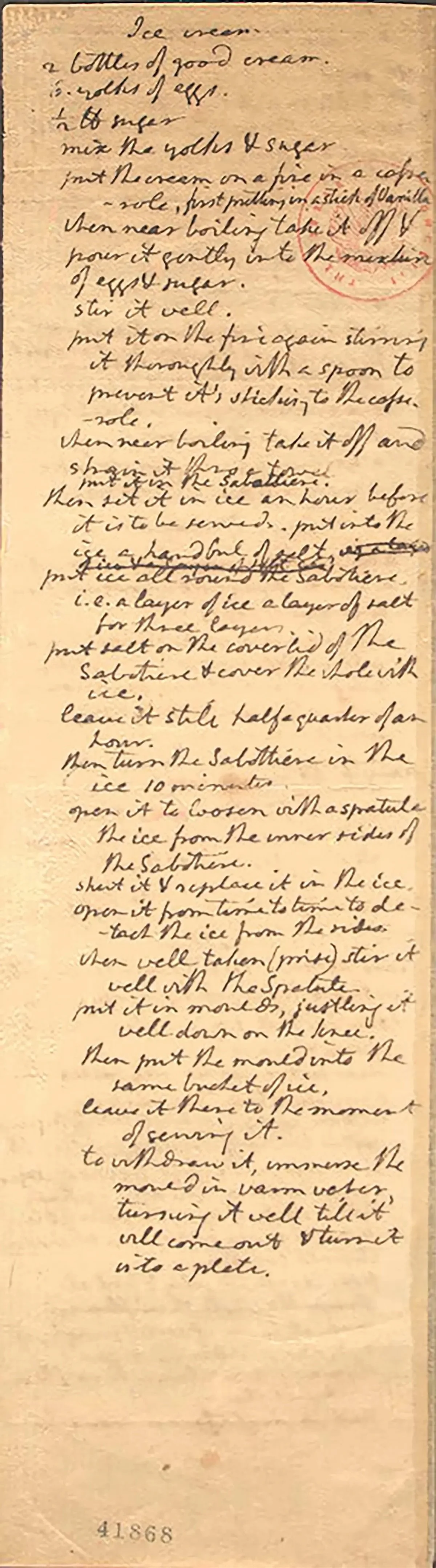
******* Not too far below you’ll find James Hemings’ RECIPE — Based on a manuscript “penned” by Thomas Jefferson in the early 1790s—documenting a recipe masterfully developed by Chef James Hemings — who most certainly had already penned this recipe and variations of others in both French and English years before Jefferson “captured” it with a sense of anxious entitlement — but we won’t go ‘there’ here. What matters most is that —this is in fact ( …. can i git another drumroll please? 🥁 ….): THE very FIRST ever vanilla ice cream recipe recorded in America’s history! 🇺🇸 Quite an exciting “BFD” factoid during our nation’s birthday month as we continue recognizing its 250th Anniversary year, huh?!
That’s right what we have here👇🏾 remains the true genesis point for vanilla ice cream entering the United States — and the earliest physical proof of any American(s) writing down instructions for making this (then ‘exotic’ — and very elite) flavor of this creamy, cold confection that would ultimately become this country's default FAVORITE. It’s not lost on me that the recipe penned in Jefferson’s hand (you’ll see a pic of it below) simply says “Ice Cream” at the top. No wonder vanilla is what most people today think of or visualize when hearing or looking at those two words.
Which makes it galling and appalling that a century-plus later, Black people throughout the Jim Crow South were customarily prohibited from eating/having/enjoying vanilla ice cream 🍦— except, the story goes, on the Fourth of July. Never an actual law. Just a humiliatingly bullying tradition turned protocol — enforced through gatekeeping and violence. Maya Angelou recalls it in her autobiographical work, “I Know Why the Caged Bird Sings” and Audre Lorde spoke and wrote of it as well from firsthand experience. My colleague and friend, Michael W. Twitty has also written about the profound generational impact this had on his father’s family in South Carolina…
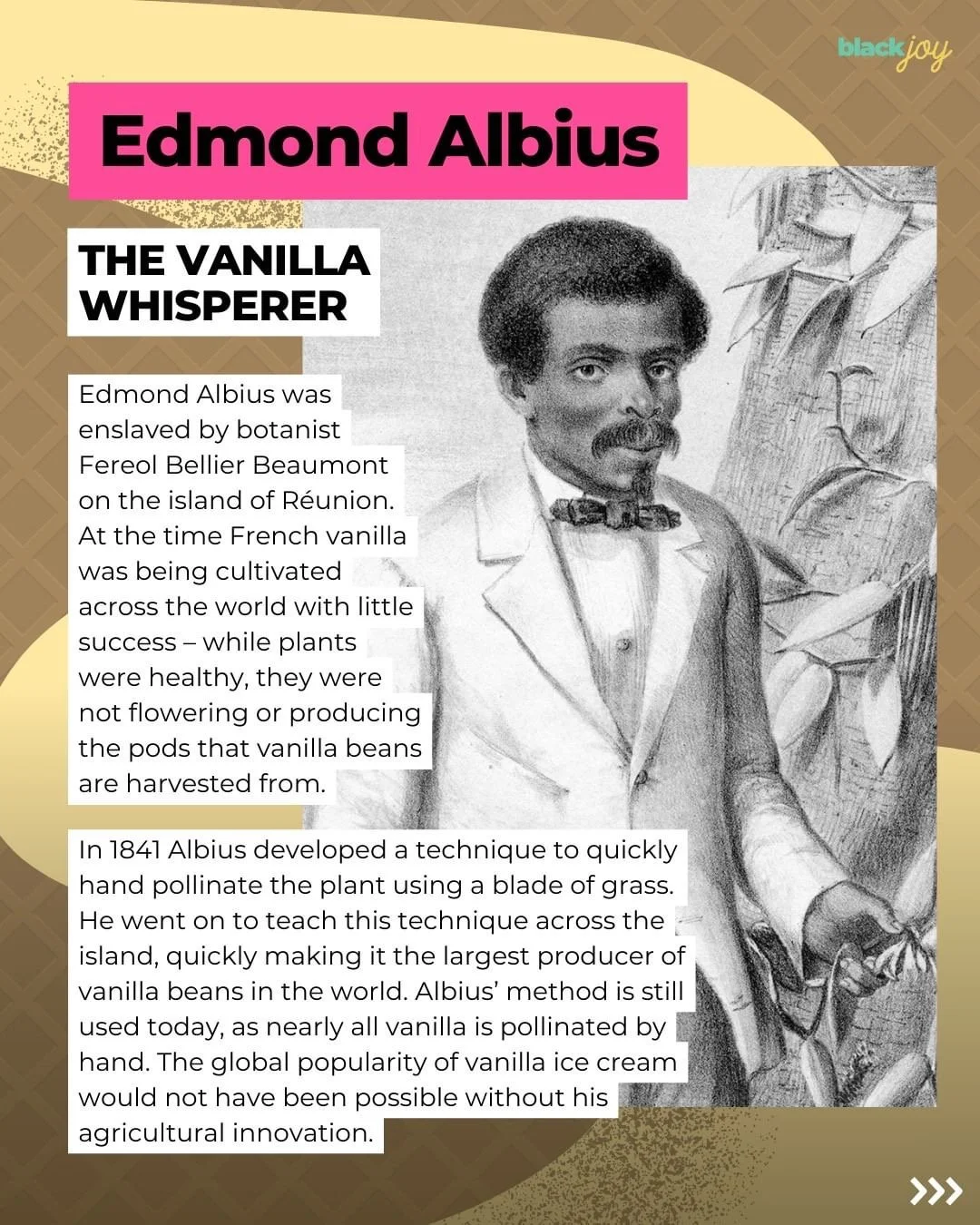
But let’s hold that upsetting yet rather “ironic” thought for now — galling and appalling considering that we only have accessible, affordable vanilla ice cream at all thanks to two enslaved men (each of whom eventually won their freedom) — who lived in two different parts of the world and at different points in the historical timeline. You've met one (yes, James, b. 1765). You’ll meet the other (b. 1829) in just a bit … 🕰️ 👀 But I will just say for now on their behalf, "You're Welcome, America!" [which is also the working title of my forthcoming book 📖 ✍🏽👩🏽💻 by the way…]
********
In The Beginning. . .
Chef Ashbell was the first to bring to my attention — and many others' — that before James Hemings, American ice cream was, to put it kindly, a milkshake with ambitions. James came home from France in late November of 1789 (3 days before the first federally suggested Thanksgiving on record under the newly ratified U.S. Constitution — a timing made only more interesting considering that Jefferson is on record having refused to acknowledge it — which is a whole separate story — but so much for my grand ideas of how fab Thanksgiving woulda been for him that year! 😆) — Anyway, James arrived classically trained, and the ice cream we all expect now — firm, rich, actually scoopable — starts then and there with him and HIS rarefied skillset and talents — expressed time and time again at Thomas Jefferson's many dinner tables and dining events (in VA, PA, NY…).
About that "Penmanship"
Like I said before, James was literate in both French and English — a chef who trained in Paris for 5+ years, keeping his own notes in two languages. Every reason to deduce that he wrote this recipe (and then some) down long before Jefferson did. But then, as it often still is to this day, given Jefferson's stature/position, he's the one who gets the official byline, the authorship — and ALL of the credit for introducing a now iconic game changing dish he had never learned, painstakingly perfected nor prepared the countless number of times James had.
The Frustrating Part . . .
Infuriating by today's standards — but in 1796, the norm: an engineered and inherited caste system that worked exactly as designed and intended, where everything (and everyBODY, literally) in Jefferson's world existed for his benefit, gain and glory. So whatever James made, Jefferson owned. Whatever James mastered, Jefferson got the credit for. Regardless of James' incredible skill, intellect, accomplishments or amazingness — because technically and legally he was part of TJ's personal property. And his existence was invisibilized, with a fate to be all but erased from the annals of history.
That erasure is exactly what I'm in the business of undoing. Which is why I do the work that I do. Far too many historic injustices need to be and can be course-corrected and righted, but only if we revisit and re-plate…
👆🏽The kitchen inventory list that James wrote for Jefferson, on February 20, 1796 in large part in support of his ‘transfer of wisdom’ agreement in exchange for his freedom. ~T. Hopkins
The Unprecedented Proof in the Pudding (or Custard, in This Case)
Unlike nearly every other person ever held in American bondage, there exists an actual sample of James' handwriting — tangible proof that he was a highly accomplished culinary artisan who literally brought the vocabulary of fine dining to America, beautifully capturing French culinary terminology and tools, written double-sided on a single sheet of 'laid' paper.
I'm referring to the Monticello Kitchen Inventory list that James wrote — the only surviving document written by James Hemings' hand, where he documents every pot, pan and utensil in inventory at arguably the most influential kitchen in America — one that he not only ran as executive chef but also, after his return from France, actively had to reimagine, redesign and have functionally reconfigured in myriad ways in order to accomplish the culinary marvels he'd mastered in Paris — including in order to make ice cream!
The document is dated February 20th 1796 — 2 weeks after Jefferson had at long last signed (on February 5, 1796) the deed of manumission he'd issued legally discharging Hemings from all servitude, allowing him to leave as a free man from then onward. The conditions they'd agreed upon nearly three years earlier had been met to Jefferson's satisfaction — chief among them that James train his brother Peter (and, as it turns out, other Monticello and even neighboring Madison plantation cooks along the way. You're Welcome, Jefferson! You're Welcome, Madison!…).
Now, About That Ice Cream Equipment . . .
Crank-handle ice cream makers didn't exist yet. In the 1790s it took grueling, hours-long labor that demanded very specific tools — and James' list includes every single one of them:
"2 Freising moulds" — ice cream wasn't served in individual scoops. It was frozen hard inside decorative pewter or copper molds, then unmolded onto a platter like a centerpiece. (Which had arrived among the 86 crates Jefferson shipped to Monticello from France.)
"1 Sorbetiere" (or Sabottiere) — the critical vessel. James poured the warm custard into this cylinder, set it inside a wooden bucket packed with ice and salt, and twisted it back and forth by the handle, by hand, for hours.
"12 Copper stew pans" — because that rich custard base had to be cooked first… (see also the actual recipe below re: "NEAR boiling")
"Flannel strainers" / "Towels" — to strain the custard "thro' a towel" so it came out perfectly smooth.
***********
And How Did We Get So "Lucky" That a Kitchen List, Catalogued By James Hemings' Own Hand, Still Exists? When Absolutely No Other Tangible Trace from Him Directly Does?
First let's take a look at "Jefferson's document" (i.e. the ice cream recipe) that fits on one side of a single sheet of paper. It's one of only ten recipes known to exist in his handwriting — and Monticello itself says outright that they "were most likely dictated to him by others." Yes, there is strong indication that "somebody" stood there and told him (surely at Jefferson's behest). Hmmm, who on earth might've "possibly" been at least ONE (or all?) of those somebodies? …James, ya think?!
Jefferson is so welded to this recipe as its ‘owner’ — his name forever imbued in a document containing the ingenuity, the intellectual property, the instruction — that only the actual practitioner of it could possibly have provided. Yet Jefferson was no such practitioner. As Ashbell says in that short but powerful 1 min punch of a clip above: "Jefferson never cooked a *&%$ thing!" That said, this how-to 'document', in another time and place (with any sense of ethics, truth and fairness), would be credited to James as its creator and author.
On the other hand, the document penned by and attributed to James is widely regarded as the only known surviving, secular (not religious), professional (as in not a personal plea, nor a poetic expression) document revealing technical, invisible mastery written (bilingually no less!) entirely by an enslaved / recently manumitted person in American history — one that in reality could only have been written by someone as intimately familiar not only with the French and English names of each item but also their comprehensive use, application and purpose. Something that Jefferson, without having had James' actual lived (and worked) experience, could not have easily done accurately or properly whether it was dictated to him or not. Oh, and did I mention that James' immersive command of spoken French easily outmatched Jefferson's much more reserved grasp of the language? (just couldn't resist adding in that snarky 'fun fact' 😆)
So yeah, said all that to say: This list exists and endured entirely because it was of great value to Jefferson to have and hold that information (accurately). And let's not pretend that it didn't also serve to assure Jefferson that, as James would soon be walking away with his freedom, he would not be doing so with any of Jefferson's inert property:
Every copper pan, every mould, every flannel strainer — named and accounted for, by the documentation of someone who himself was once counted as property — the kitchen equipment that James knew and understood like no one else on that plantation or anywhere else in America at that time — not even Jefferson himself. It was also a precautionary documentation for the now ‘free’ man that James was to not ever be accused of taking what was not legally his. As if to say: here’s all your culinary property accounted for, TJ. I, on the other hand, no longer am included in that count.
And with that, James left only with what he knew and could masterfully, artfully do. Which was everything.
📄 [⬇️IMAGE: “Jefferson's” handwritten recipe circa 1793] • 📄 [⬇️IMAGE: James' 1796 kitchen inventory]

Wait — Don't Just Gloss Over That Vanilla Line Item!
In the 1780s vanilla was among the most expensive natural flavorings on earth for one reason: it only came from one place — the Veracruz region of what was then New Spain (present-day Mexico), where the Totonac people had been cultivating it for centuries before anyone in Europe knew it existed. Not for lack of trying elsewhere. Europeans hauled cuttings out to tropical colonies all over the map, Réunion and Madagascar included. The vines took root just fine. They even flowered. They just never fruited. No pods, no beans, no vanilla — because the pollinator that could do the job was a bee that lived nowhere but there.
So New Spain held a monopoly on the world's entire supply. And it stayed that way until 1841 — a good fifty years after James was making this ice cream — when a twelve-year-old enslaved boy on Réunion named Edmond Albius worked out how to pollinate the flower by hand. A sliver of bamboo, a flick of the thumb, seconds per bloom. It's still the method used today.
So this recipe wasn't calling just for a flavor. It also called for (and cost) a fortune during James' era…
And now you've met them both. James, who gave America its very first vanilla ice cream recipe, and Edmond, who gave the world the bean. Neither man free when his great (known) accomplishments were achieved. Neither credited for it while he lived.
And a century later, their descendants would be turned away from the counter — refused a scoop of the very thing that would not exist without them. That's the galling and appalling part. Which is why I’ve said it multiple times.
AND NOW, WITHOUT FURTHER ADO, I PRESENT TO YOU:
🍦 THE RECIPE 🍨
Based on the one recorded by Jefferson's hand. But entirely created from James' head… heart — and tireless hard work!
Added bonus: my commentary including mention of Chef Ashbell's important adaptations* — which sets you up to make some amazing vanilla ice cream a la James!
Ingredients:
2 bottles* of good cream
6 yolks of eggs
½ lb sugar
A ‘stick’ of vanilla (long pod)
My Commentary on the ingredients:
Bottles? Not cups. Not quarts. Bottles — a measuring ‘unit’ everyone agreed on and nobody defined. Best guess: about a quart and a half. Ashbell rounds up to two quarts of heavy cream, because when in doubt: more cream’s better than not enough.
The sugar. Ashbell keeps the half pound exactly, and calls for unrefined raw sugar — closer to what was in that kitchen than modern, less naturally flavorful bleached varieties.
The six egg yolks. FYI over time nearly everything in this recipe would drift and depart from what the original source would have really been like. But the six yolks never budged for this “Jeffersonian” (JAMES) recipe. Those golden egg parts are what make this custard-style ice cream set and stand out instead of slosh — and it's what that 1 min video clip establishes out the gate. (Rather astonishingly though requiring eggs for making ice cream does eventually get dropped out altogether — by another Black ice cream innovator named Augustus Jackson in 1830s Philadelphia who figured out and built a fortune on an eggless version that became "Philadelphia’s signature-style" —a lighter American answer to the richer French custard persuasion)…
James’ Instructions As Scribed By Jefferson:
🥄 Mix the yolks & sugar.
🥛 Put the cream on a fire in a casserole, first putting in a stick of Vanilla. When near boiling take it off & pour it gently into the mixture of eggs & sugar. Stir it well.
🔥 Put it on the fire again stirring it thoroughly with a spoon to prevent it's sticking to the casserole. When near boiling take it off and strain it thro' a towel.
🧊 Put it in the Sabottiere, then set it in ice an hour before it is to be served. Put into the ice a handful of salt… turn the Sabottiere in the ice 10 minutes… open it to loosen with a spatula the ice from the inner sides.
👩🏽🍳 Put the mixture in moulds, justling it well down on the knee… to withdraw it, immerse the mould in warm water, turning it well till it will come out & turn it into a plate.
My Commentary on the Instructions:
"Near boiling" is the difference between silky custard and expensive scrambled eggs. Ashbell version? "DO NOT BOIL" — all caps — and he means it.
Ashbell's twist dials up the flavor: pull the bean out, split it, scrape the seeds, stir them back into the hot cream. Yum.
Ashbell swaps the open fire for a double boiler — gentler, and forgiving if you're not an 18th-century hearth-taming chef. Cook until it coats the back of a wooden spoon, then cool completely.
A "sabottiere" is the ice cream maker — a lidded metal canister you bury in ice and salt and turn by hand, scraping the frozen edges back in. For an hour. Ashbell's mercy: a churn, a machine, or freezer trays. Note the salt is for the ice, never the custard — a pinch in the custard is a modern habit, and optional.
"Moulds" are decorative metal forms, often fruit or flower shapes, that the ice cream gets packed into and frozen solid inside. Which brings us to the part everybody drops…
This dessert does not get scooped into a bowl. It gets unmolded onto a plate. That's architecture. That's the signature dish of the night.
Why Ashbell's Approach Matters So Much:
By the 20th century this recipe had been "modernized" nearly out of existence — a 1938 version swapped the vanilla bean for extract (added after cooling, so it never steeps), cut the cream, dropped the molds. Uses bleached white commercialized sugar (possibly ‘cut’ with other ingredients). Convenient? Sure, but barely what James originally brought back to us.
What Ashbell did was to go in the other direction. He didn't aim to embrace or validate the ‘modernization’ — instead he set out to put it back the way it was supposed to be. And he refers to the recipe as it truly is, rightfully restored to its originator as James Hemings’ Recipe.
[🍨 MORE SPRINKLES]
[More Extra Special clips in progress including selected video clips from my (vanilla) ice cream history talk, making and tasting at Historic Lefferts House the Summer of 2023!]
🍦 ADDENDUM: Annotated Related Scoop for You to Seek Out to See and/or Hear As You See Fit!
As a bonus to the bonus, below is my semi-comprehensive list of the various and sundry content, mediums and media outlets I've either created or contributed to re: the origins of American ice cream — with hyperlinks so you know exactly where they are — Enjoy!
🟣 TFG ICE CREAM Podcast episode → the origins of ice cream in America, told in full — the hidden history I scoop up start to finish.
🟡 "Chasing Flavor" with Chef Carla Hall — the ICE CREAM episode (streaming on HBO's MAX) → I'm the on-camera Culinary Historian, serving even more ice cream insight.
🟢 Milk Street Radio summer episode → I serve host Christopher Kimball other pieces of the (previously) hidden origins of American ice cream. ➕ the Milk Street mini-video you saw some of above but on IG.
🔵 An Ice Cream–themed Culinary History Talk (& Tasting!) → at Lefferts Historic House a summer or so ago. Insightful clips from this 45-minute talk are being turned into a highlight video to include here on this VIP page when it’s done…
Before You Go, A Few More Timely Things to Know:
🍦 IT’S STILL #JamesHemingsJuly!🎂 🧑🏽🍳 🍝🍟 🍨🍦🍮
Each July I turn this month over to James — because the food holidays he actually earned credit for happen to cluster right here. Here's why I started calling it that → And the JAMES HEMINGS HUB → my whole James Hemings collection in one place.
And REMEMBER: 🇺🇸 July 4th 🎆 only marked the start — the official, formalized spark. 🧨
Commemorate & celebrate America's 250th and its many milestones with Revolutionary Food & Drink… Much of which has connections to James’ legacy…
AND LASTLY FOR NOW BUT MOST CERTAINLY NOT AT ALL LEAST!…
The work I do I call Applied Culinary History:
Products, Places, Persons, Platforms — all have untold, engaging stories. I help them discover and tell them insightfully, from well-informed and often inspired positions.
By reconnecting the past with the present, I provide the much-needed and almost always missing context that leads to better decisions and better results — instead of the 'luck' this entire industry seems to bank on. Intel that informs and can transform menu design, dishes and drinks offered, how they're described.
🍽️ Work With Me — TFG (The Food Griot) aka Tonya Hopkins | CLICK LINK BELOW ⬇️ TO CONNECT 👇🏾