By: Tonya Hopkins, aka “The Food Griot”…
As a food historian focused on early American foodways through a Black cultural lens, a few years ago I once stumbled upon a curious ‘culinary’ fact that I’d never seen mentioned anywhere else: two of Virginia’s most iconic culinary figures—Thomas Jefferson (b. 1743) and Edna Lewis (b. 1916) — were both born on April 13th. Both in the Piedmont region of central Virginia. 173 years apart….
It struck me not only as an uncanny coincidence but as a compelling portal into the paradoxes of American food history.One, a founding statesman born into colonial power and privilege.
The other, a groundbreaking Black woman chef raised in a freed-slave farming community just miles away—nearly two centuries later.
Jefferson famously used food as diplomacy, importing European styles to signal status and influence. Edna Lewis, by contrast, devoted her life to preserving and elevating rural Southern foodways rooted in Black land, memory, and tradition. Both left a profound mark on American cuisine—but in radically different ways.
And what—or who—connects them?
Chef James Hemings. Born into bondage in 1765 and enslaved by Jefferson, Hemings became the first American trained as a French chef. He cooked for Jefferson in Paris and at Monticello and played a formative role in shaping the tastes and techniques Jefferson is often credited with introducing. Hemings helped lay the very foundation of what we now call American fine dining.
Yet James’ story was largely erased.
If not for the efforts of myself, Ashbell McElveen, and Karma Martell in founding the James Hemings Society over a decade ago, his name might still be hidden beneath Jefferson’s legacy. When I first noticed the shared birthdate between Jefferson and Lewis, I was in the midst of co-founding the society and researching Edna Lewis’s career—which spanned mid-century New York and helped bring Black Southern cuisine into the spotlight.
Her legacy is layered with reverence, regional pride, and a quiet but firm resistance to erasure.
And as for Hemings? Since enslaved birthdates were rarely recorded, it’s entirely possible—if not likely—that he too was born on April 13.
How cosmic would that be?
Curious how James Hemings connects Jefferson to Lewis?
Talk about culinary ancestry.
💫 Paid Patreon subscribers get first looks at these kinds of insights and untold food history connections—stories that shift the narrative and center the cooks who’ve shaped America’s table.
👉🏾 Join me on Patreon for deeper dives and exclusive reflections.
Already a patron? Don’t forget to redeem your perks—I’ve got more stories waiting for you there.
🔗 [Click here to return to the full culinary calendar for more food & drink holiday explorations.]
What or WHO is the bridge between these two icons, you ask? None other than Chef James Hemings (b. 1765), the enslaved, classically trained chef who was owned by and worked under Jefferson—and who helped profoundly shape the development of American cuisine and fine dining from Jefferson’s many tables in multiple states and across the Atlantic…
Too often, conventional food history narratives credit Jefferson alone, overlooking the skilled hands and brilliant mind of Hemings, whose name was barely known to the public until recent years. If not for the work that Ashbell McElveen, Karma Martell, and I did to establish the James Hemings Society over a decade ago, his story might still be buried further beneath Jefferson’s shadow.
I’d first pieced the duality of ‘same born dates’ and timelines together while co-founding the James Hemings Society and, at the same time, researching and speaking (alongside Michael Twitty and Judith Jones) — my focus on Edna Lewis’s life work as an accomplished chef and cookbook author, that took flight and flourished in New York City, spanning the mid to late 20th century. Her culinary career—steeped in reverence, rigor, and regional pride—serves as a sizable slice from our multilayered, marbled cake of American food history.
To add yet another layer of frosting—and intrigue… since the birthdates of the enslaved were rarely recorded or passed down, it’s entirely possible that Hemings, too, could have been born on April 13th.
How cosmic would that be? …
**********##########################************###########################************######
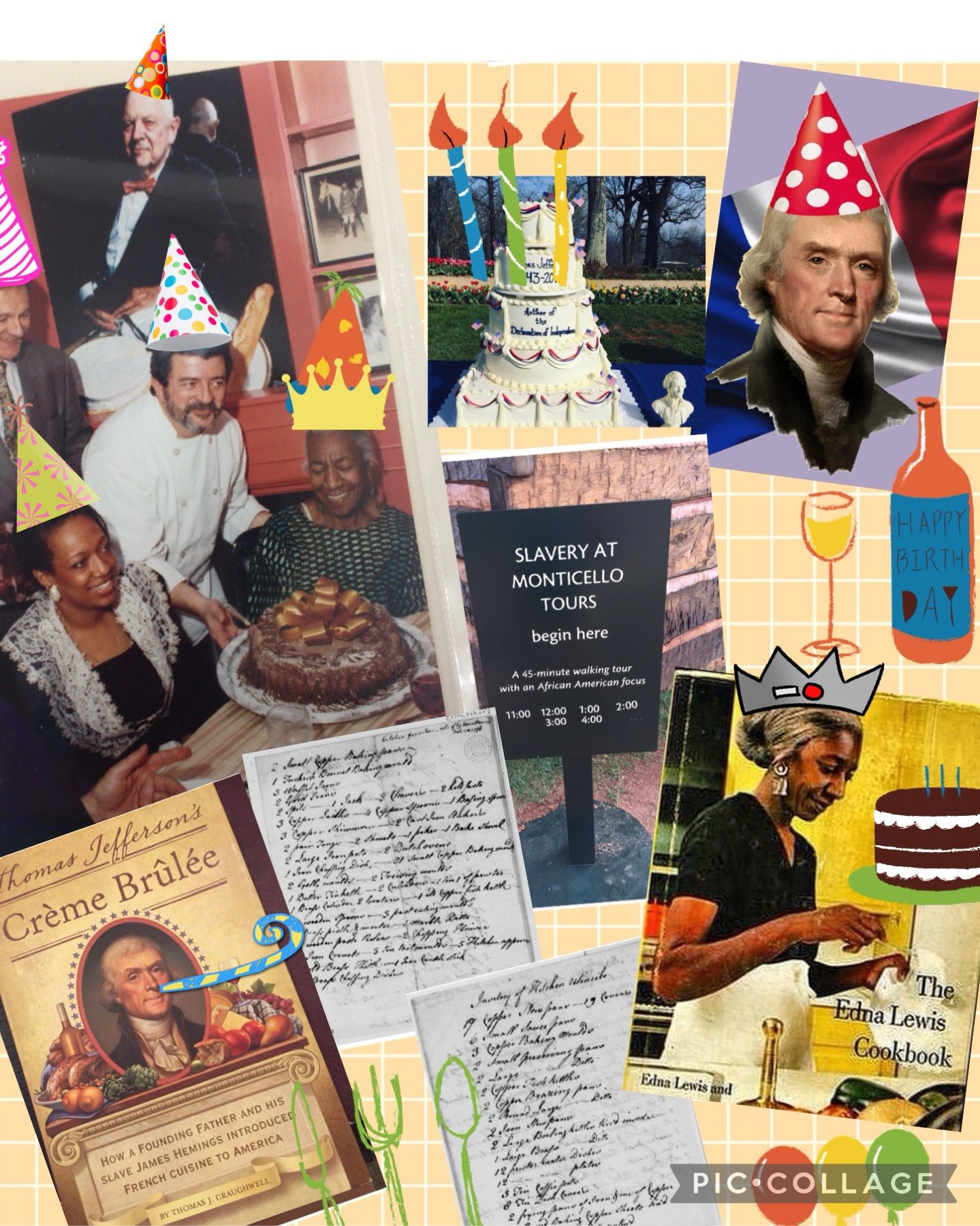
A photo collage i created to convey the concept of the birthday date shared by both TJ and Chef Lewis… including photos of Mrs. Lewis celebrating her special day at the James Beard House once upon a time, seated to her left is her neice Nina Williams-Mbengue, board member of the Edna Lewis Foundation.
Jefferson, Hemings & Edna Lewis: Virginia's Cosmic Culinary Trifecta —
Were They Each Born On April 13th?
By Tonya Hopkins, aka "The Food Griot"
Two of Virginia's most iconic culinary figures — Thomas Jefferson (b. 1743) and Chef Edna Lewis (b. 1916) — share the same birthday: April 13th. Both born in the Piedmont region of central Virginia. 173 years apart.
As a food historian focused on early foodways in the Americas — through a Black and African Diasporic cultural lenses — some years ago I noticed this cosmic culinary coincidence and have yet to find any other writings or commentaries about it to any extent. Hence this piece as it seemed to me to not only be an uncanny coincidence but also a compelling portal through which to examine the paradoxes of American food history:
One, a founding statesman born into colonial power and privilege [THIS IS MISSING AND MUST HAVE ADDED HIS LITERAL OWNERSHIP OF OTHER PEOPLE STATUS… A VIRGINIAN “PLANTER”/PLANTATION OWNER NOT UNLIKE PRESIDENT #1. AND 4, 5, 6, 7 — fact check that but the point is an alarming # (majoarity?) of the first 10 or so presidents were slave holders ] . The other, a groundbreaking Black woman chef raised [DESCENDENT OF THE ENSLAVED NOT UNLIKE WHO JEFFERSON OWNED EVEN THOUGH YOU DON’T HAVE TO SAY THAT LITERALLY BUT….] in a freed-slave farming community just miles away — nearly two centuries later.
Jefferson used food as diplomacy, importing European styles to signal status and influence [ADD ONE OTHER SHORT PHRASE ABOUT HIS C. Edna Lewis on the other hand devoted her life to preserving and elevating rural Southern foodways rooted in Black land, memory, and tradition. Both [WERE FOCUSED ON SEASONAL PLANTING AND HARVESTING AND EACH left a profound mark on American cuisine — but in radically different ways.
And [THE GLUE — OR SOME KIND OF CULINARY TERM THAT COULD MEAN GLUE] connecting them? Chef James Hemings (B, 1765)
Born into bondage in 1765 and enslaved by Jefferson, Hemings became the first American CLASSICALLY trained as a French chef. He cooked for Jefferson in Paris and at Monticello AND IN PHILADELPHIA AND IN NEW YORK… ,[CLAUDE IT IS CRITICAL TO INCLUDE THE MULTIPLE LOCATIONS B/C THEY ARE EACH HYPERLINKED TO OTHER RELATED POSTS] playing a formative role in shaping the tastes and techniques [AND NOW ICONIC AMERICAN CLASSIC DISHES] Jefferson is so often credited with introducing [TO OUR NATION? TO AMERICANS?] . Hemings helped lay the very foundation of what CAME TO BE American fine dining — yet his story was largely erased.
If not for the work that Ashbell McElveen, Karma Martell, and I did MORE THAN A DECADE AGO in co-founding the James Hemings Society, his name [PREFER: THE NAME OF OUR NATION’S FOUNDING CHEF] might still be buried beneath Jefferson's shadow. It was during that research — while also studying and speaking on Edna Lewis's career ALONG SIDE — YES I “want the Judith Jones/Michael Twitty detail restored —WHY WOULD YOU CUT a credibility-building name-drop worth keeping???] — that I first pieced this duality of shared birthdates and timelines together. Lewis's culinary career — steeped in reverence, rigor, and regional pride — took flight in early to mid-20thcentury New York and OVER TIME / OVER THE YEARS LEADING UP TO THE LATTER 20TH…] helped bring [DELETED BLACK B.C SHE REALLY WAS A CHAMPION OF SOUTHERN AT LARGE NOT JUST BLACK]. Southern cuisine into the highest echelons of American fine dining. Her legacy is layered with quiet but firm resistance to erasure. Sound familiar? [I NEED TO DO A STRATEGIC SHOUTOUT TO GAGE& TOLLNER HERE. THEY ARE A PROSPECTIVE CLIENT FOR MY CULINARY COCKTAILS WORK — YES I HAVE A COCKTAIL FOR EDNA BUT NO DETAILS TO GIVE YOU HERE JUST YET SO LET ME KNOW HOW YOU WANT TO FRAME IT
And then there's this: since the birthdates of the enslaved were SYSTEMICALLY/ INTENTIONALLY NOT DOCUMENTED? REMEMBERED THE WAY THEY ARE CELEBRATED SO MUCH IN THE OWNER CLASS — THEIR SPECIALNESS VS. THE INTENDED INSIGNIFICANCE OF THE OWNED]… WHETHER THEY WERE recorded OR NOT THEY WERE NOT CONVEYED AND THEREFORE THE DATES WERE NEVER KNOWN NOR passed down, it's entirely possible — [ DELETE “ if not likely” — THAT’S AN UNWARRANTED STRETCH] — that Hemings, too, MAY HAVE BEEN born on April 13th. [COME UP WITH A MORE CREATIVE WAY TO SAY BORN ON. ITS BORING TO KEEP SAYING BORN ON….]
How cosmic would that be?
RE: “ If you want the "talk about culinary ancestry / enduring influence" line restored, I can add it back before the CTA.] —DIDNT YOU ALREADY COVER ANCESTRY ENDURING INFLUENCE ABOVE? OR WAS IT A DIFFERENT POINT?
💫 Paid Patreon subscribers get first looks at these kinds of insights and untold food history connections — stories that shift the narrative and center the cooks who've shaped America's tables. Join me there for deeper dives, and if you're already a patron, don't forget to redeem your perks.
🔗 [THIS LINK Returns you to the full culinary calendar]
%%%%%%%%%%%%%%%%%%%%%%%%%%%%%%%%%%%%%%%%%%%%%%%%%%%%%%%%%%